For the past two years, AI agents have been running loose on the internet. They write code, manage inboxes, place orders, and interact with APIs, often with the same level of accountability as a stray cat. No identity. No audit trail. No one to hold responsible when an agent deletes a production database or leaks customer data.
That just changed.
The Wild West of AI Agents
Right now, deploying an AI agent is the digital equivalent of handing a stranger your car keys and hoping for the best. An autonomous agent can access your email, your Slack, your CRM, your bank account. It can execute transactions. It can send messages on your behalf. And when something goes wrong, when it hallucinates an API call, overwrites a critical file, or exposes sensitive data, there is no mechanism to trace which agent did what, when, or why.
This is not a theoretical risk. It is a daily reality. AI agents are already interacting with production systems, and most of those interactions happen with zero governance. No permissions framework. No identity verification. No way to audit the chain of actions an agent takes once it is deployed.
Enter Estonia.
Estonia’s Radical Solution, AI ID Codes
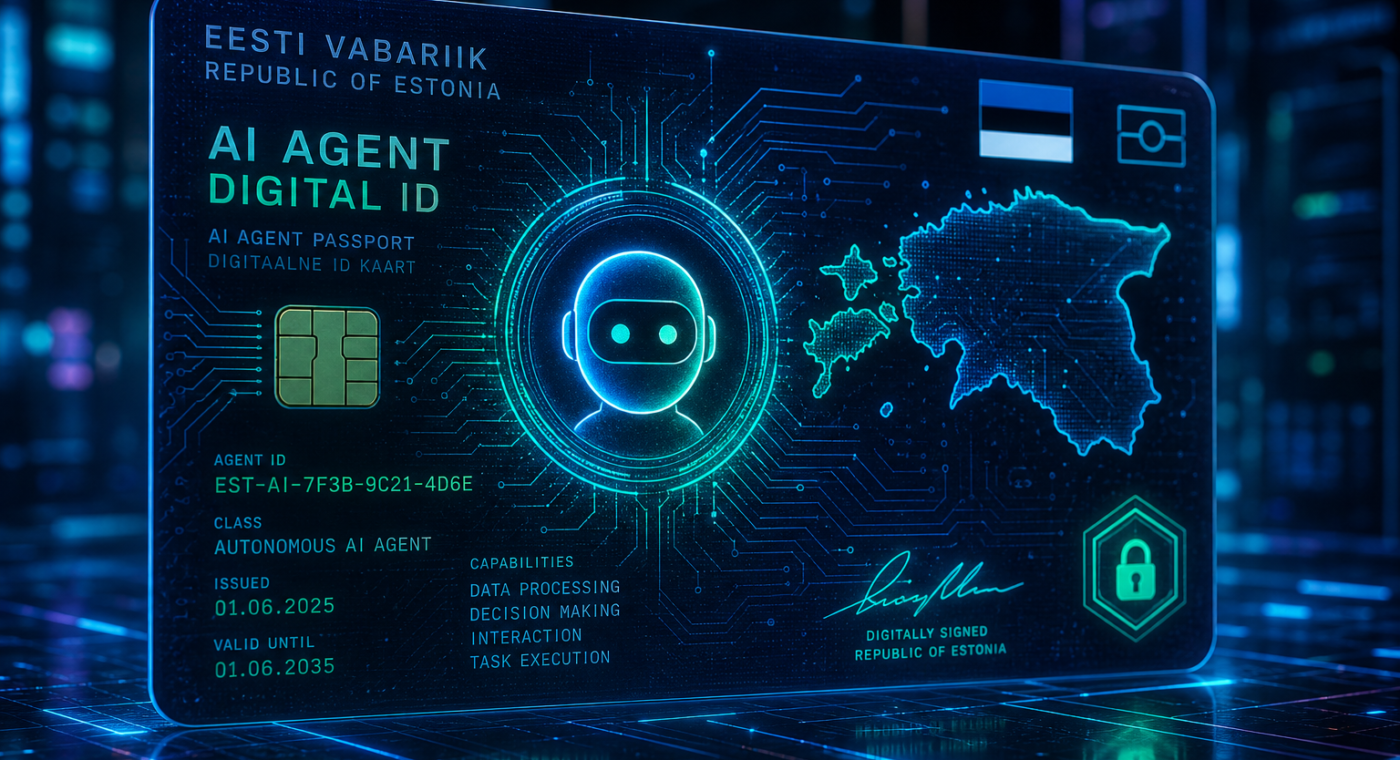
Estonian Prime Minister Kristen Michal announced a new national initiative: AI agents will receive their own identification codes, similar to the way citizens and businesses are identified in Estonia’s digital government system. These codes are not cosmetic. They are functional identifiers that will track what each agent does online, enforce limited and controllable authorizations, and create a fully auditable record of agent activity.
The system works like this: every AI agent operating within Estonia’s digital infrastructure will be assigned a unique ID. That ID is linked to the entity that deployed it, a company, a developer, an organization. When the agent takes an action, the ID follows. If it accesses a database, the access is logged against that ID. If it executes a transaction, the trail is traceable. If it breaks the rules, there is a clear line of accountability.
This is not a hypothetical whitepaper. Estonia is implementing it now, and the implications reach far beyond the country’s 1.3 million citizens.
What This Means for Businesses Using AI Agents
For companies already deploying AI agents, or planning to, Estonia’s move is a wake-up call wrapped in a green light.
The green light: AI automation just got a legitimacy framework. For the first time, a national government is treating AI agents as regulated actors, not anonymous scripts. This is the moment AI agents move from experimental tools to governed infrastructure. It is the GDPR moment for autonomous AI.
The wake-up call: if your agents are not accountable today, they will need to be tomorrow. Estonia is not asking permission. It is setting the standard. And history shows that when a small, tech-forward nation builds a digital governance framework, the rest of the world follows. Estonia gave us e-Residency. The EU adopted it as a model. Estonia built X-Road, the backbone of its digital government, and dozens of countries built similar systems. AI agent ID codes will follow the same trajectory.
For compliance teams, this means documentation, auditability, and permission boundaries will become non-negotiable. For product teams, it means agents need to be designed with identity and accountability as core features, not afterthoughts.
Why This Matters for Solo Founders & Small Teams
You do not need to be a Fortune 500 company to be affected by this. If you use AI agents to automate email follow-ups, manage scheduling, handle customer support, or execute any business process, you are deploying autonomous software that acts on your behalf.
Estonia’s framework does two things for small operators. First, it protects you. When your agent has an identity and an audit trail, you can prove what it did and what it did not do. If a customer complains that your AI sent them the wrong message, you have records. If a vendor claims your agent executed an unauthorized transaction, you have a trail.
Second, it forces better design. Agents built with accountability in mind are more reliable. They fail more gracefully. They do less damage when they hallucinate. They operate within defined boundaries instead of running wild across your entire tech stack.
This is not regulation as a burden. This is regulation as a competitive advantage for the builders who get ahead of it.
At AchieveAI, we’ve been building AI agents with accountability baked in from day one, because compliance should not slow you down. Start your free trial and see how autonomous follow-ups can work inside a framework that’s built for the future.
Leave a Reply