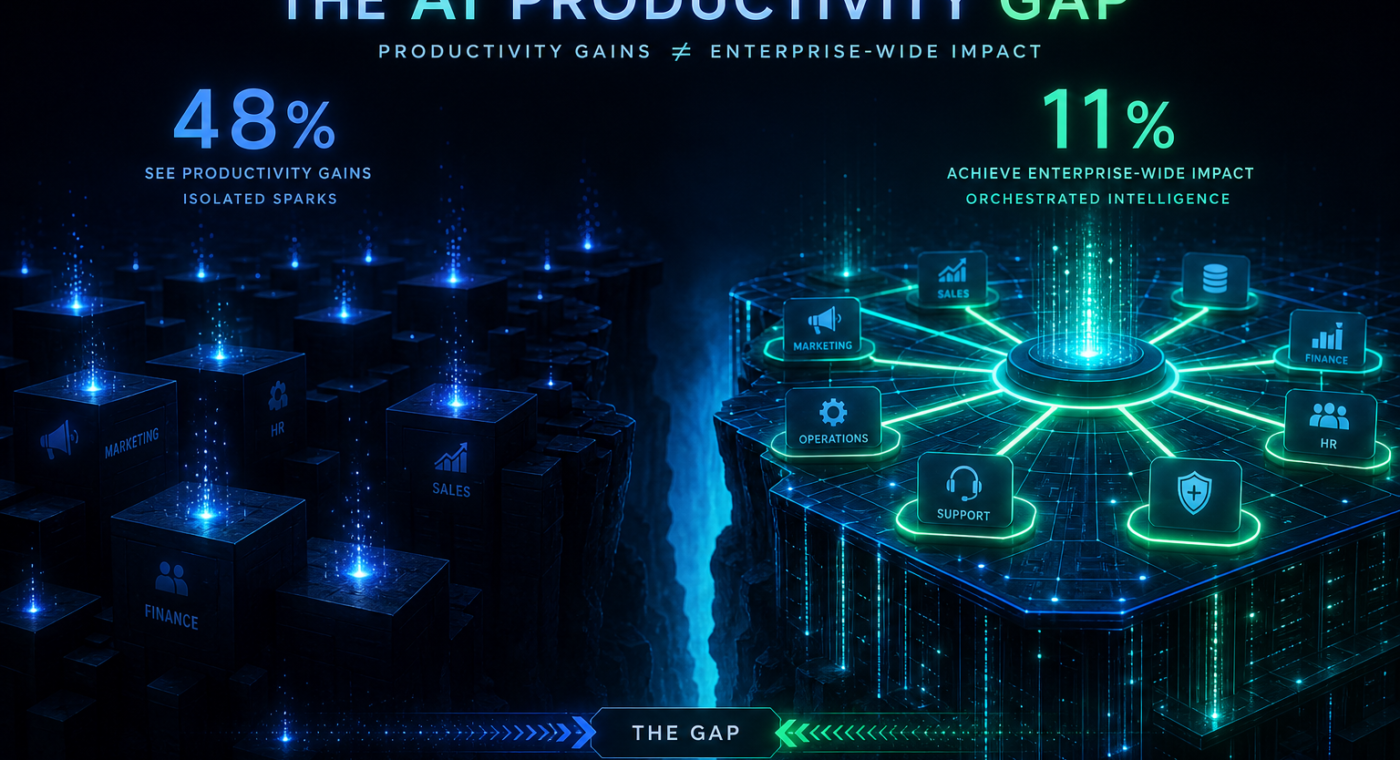
Nearly half of organizations say AI has improved their productivity. Only 11% say it’s moved the needle across the entire enterprise. That gap isn’t a rounding error. It’s a structural failure, and KPMG just put a number on it.
KPMG’s Transforming the Enterprise 2026 report, published June 18, surveyed 1,750 senior transformation leaders across 20 countries. The finding is stark: 48% report significant AI productivity improvements in specific areas, but a mere 11% see substantial enterprise-wide impact. The technology works. The deployment doesn’t.
For founders and executives running lean operations, this isn’t abstract. It’s a direct threat to your runway.
The Core Problem: AI On Top of Fragmented Workflows
Most organizations didn’t redesign their work when they adopted AI. They layered it on top of existing, disconnected systems. Teams got a new chatbot here, an automation there, a prediction model somewhere else. Each tool optimized a silo. None of them optimized the whole.
The result is productivity that appears in pockets but never compounds. You get a faster draft in one department and a manual handoff in the next. You get a smarter forecast that no one acts on because the decision-making process hasn’t changed.
This is the productivity paradox KPMG identifies: gains are real but trapped. They don’t flow through to the bottom line because the underlying workflow architecture wasn’t designed to let them.
Why This Hits Solo Founders and Small Teams Hardest
Large enterprises can absorb this inefficiency. They have buffer. A solo founder or small team doesn’t.
If you’re a founder, your time is your primary capital. Every hour spent on work that could be automated, every follow-up that falls through the cracks, every client communication that requires manual intervention is a direct cost. You’re not just losing productivity. You’re losing the capacity to grow.
When you adopt an AI tool that works in isolation, you’ve added another disconnected system to your workflow. The promise of automation becomes the reality of managing another platform. The time you were supposed to save gets spent on integration and context-switching instead.
The enterprise can afford to experiment with disconnected AI. You can’t. You need systems that work together from the start.
The Hidden Cost: Trust Without Measurement
KPMG’s report surfaces another critical disconnect. Sixty percent of leaders say trust in AI is strategically important. Only 28% actually measure it.
This is like saying you care about revenue but never looking at your income statement. Trust isn’t a feeling. It’s a metric. And if you’re not measuring whether your team (or you, as a solo operator) actually rely on AI outputs for decisions, you’re not capturing the value.
For founders, this translates to a simple question: When you use an AI tool, does it reliably handle the task so you can focus on higher-value work? If the answer is "sometimes" or "I need to check it anyway," you haven’t achieved automation. You’ve added a step.
The trust gap is the productivity gap. If you don’t trust the AI enough to let it run autonomously on critical workflows, the productivity gains remain theoretical.
The Real Solution: Redesign Work Around AI
The path forward isn’t more AI tools. It’s redesigning your work and decision-making processes around AI that’s built to operate as a coherent system.
KPMG’s research implies that enterprise-wide impact comes from holistic transformation, not point solutions. For a founder, this means choosing tools that don’t just automate a task but restructure how you work.
This requires three things:
1. Contextual Intelligence: The AI needs to understand your business, your clients, and your priorities. Generic tools give generic outputs. You need an assistant that knows your context.
2. Persistent Memory: Your AI should remember previous interactions, decisions, and client details. Every conversation shouldn’t start from zero. Memory turns a tool into a partner.
3. Workflow Integration: The AI must operate across your core functions: communication, scheduling, content, and follow-up. When these are connected, productivity gains compound instead of getting trapped in silos.
Without these, you’re just adding another disconnected tool to the pile.
How AchieveAI Bridges the Gap for Solo Founders
AchieveAI was built specifically for this problem. It’s not an enterprise platform you have to configure. It’s a personal super intelligence that acts as your life OS.
Here’s what that means in practice:
- Follow-up automation that actually follows up. AchieveAI tracks client communications and ensures nothing falls through the cracks. It doesn’t just draft a response; it manages the sequence.
- Client communication with context. When a client emails or messages, AchieveAI draws on persistent memory to respond appropriately, referencing past interactions and your business context.
- Content publishing without the workflow. Creating and scheduling content is built into the system, not bolted on as another integration.
- Relationship intelligence. It knows who your key contacts are, what they care about, and when you last connected. This turns networking from a manual task into an intelligent system.
You don’t need a team of engineers to deploy it. You don’t need to integrate five separate tools. AchieveAI is the integrated system that enterprise organizations are spending millions trying to build. For you, it’s a free trial away.
Capture the Productivity AI Actually Promised
The KPMG report confirms what many founders suspect: AI’s promise is real, but the way most people are deploying it guarantees the gains never reach the bottom line.
You can be in the 11% who see enterprise-wide impact, or you can keep layering disconnected tools and wondering why productivity isn’t moving.
The choice isn’t about adopting more AI. It’s about adopting the right AI, designed to work as a complete system from day one.
Start your free trial at AchieveAI and stop leaving productivity gains on the table. Your time is too valuable to spend managing disconnected tools when you could be focused on growth.
Leave a Reply